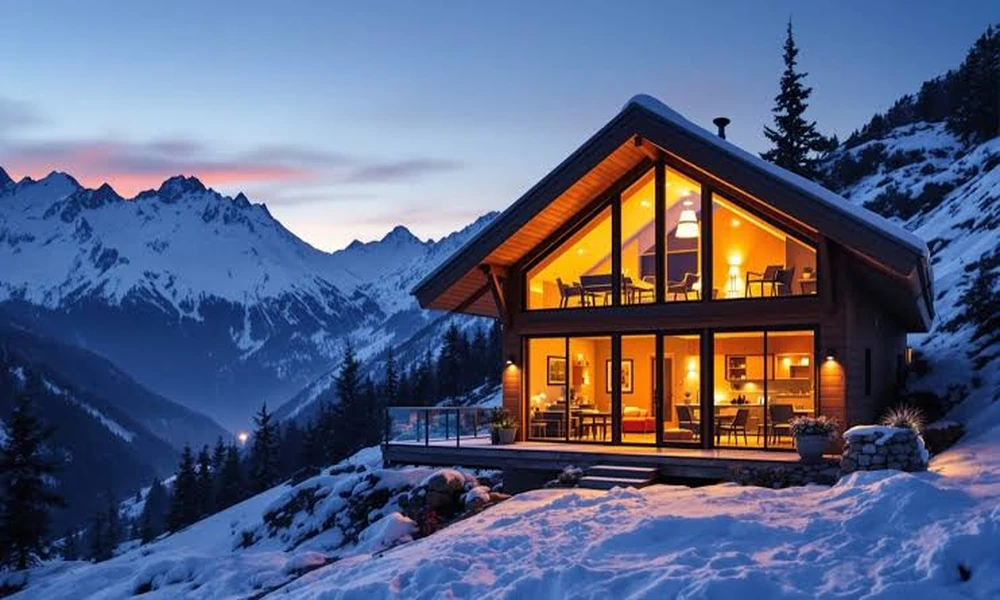
Montpelier is the largest community in the Bear Lake Valley, a farming region in southeastern Idaho that the Oregon Trail once crossed. At about 5,950 feet, Montpelier sits nearly 1,800 feet above Burley. Snowfall usually begins in October and can continue through April, with occasional May snow. January highs average around 29°F, while overnight lows fall to about 7°F. Homeowners who call on Nu-Vu Glass about replacement windows tend to ask whether new windows will really keep the house warm. U-factor, SHGC and visible transmittance can help homeowners judge how a replacement window will perform through the winter.
Understanding Window Ratings in a Cold Climate
An NFRC label on a certified window lists its energy-performance ratings. The U-factor shows how quickly heat escapes, and a lower number means better insulation. The solar heat gain coefficient, or SHGC, shows how much of the sun’s warmth passes through the glass.
ENERGY STAR sets different targets by climate zone. Under Version 7.0, effective October 2023, Northern-zone windows can qualify through two paths. The prescriptive option requires a U-factor of 0.22 or lower and an SHGC of at least 0.17. The equivalent-performance option accepts U-factors from 0.23 to 0.26 when paired with higher SHGC values, ranging from 0.35 to 0.40. This second option applies to windows, not patio doors or skylights. Under ENERGY STAR Version 7.0, glazed patio doors with more than 50% glass must meet a Northern-zone U-factor of 0.26 or lower and an SHGC of 0.40 or lower. Doors with 50% or less glazing have separate requirements.
The same logo also appears on windows certified for warmer regions, so ask whether the product is certified for your zone, and use ENERGY STAR’s zone finder to confirm your county. Idaho’s State Energy Loan Program, for instance, requires Northern-zone certification for window projects it finances. ENERGY STAR is also separate from local energy codes, which still apply.
Match Window Ratings to Each Wall
U.S. Department of Energy guidance for cold climates treats each wall differently:
- North-facing windows: the lowest U-factor you can afford, since they get little sun and mostly lose heat.
- South-facing windows: the highest SHGC with the lowest U-factor you can afford, so winter sun helps warm the room.
- East and west windows: a low SHGC, or keep them shaded.
The amount of winter sunlight a window receives also depends on nearby trees, roof overhangs and other buildings. Check those obstructions before choosing a high-SHGC product for a south-facing room.
In a Montpelier home, a south-facing living room could pick up useful warmth on a clear January afternoon, while a north bedroom is all about holding heat. Ordering the same window for every wall misses that chance.
How Different Glass Features Reduce Heat Loss
Low-E coatings reduce heat transfer through the glass, with different coating types available to control how much solar heat enters the home. Argon gas between the panes reduces heat transfer compared with ordinary air. Triple-pane units can achieve lower U-factors than many double-pane models, although the cost is usually higher. Compare the whole-window ratings and prices of the specific products you are considering.
Keep Rooms Bright Without Losing Too Much Heat
Winter brings fewer hours of natural light to the valley, making the amount of daylight inside a room especially noticeable. The label also lists visible transmittance, which shows how much light the glass lets through. Compare it along with the U-factor, especially for the rooms you use most in the morning. Check NFRC ratings for patio doors and large fixed windows too, since these products can account for a significant part of the home’s glazed area.
Window Replacement in Montpelier
Nu-Vu Glass has a Montpelier location, and its website traces the business to 1957, when a family opened a paint and glass store in Burley. Three generations later, its residential lineup includes vinyl windows, entry doors and patio doors, and the website says installation is handled by in-house certified technicians. Homeowners can contact the Montpelier team to ask which window models meet the Northern-zone criteria and request product ratings before comparing quotes.
Planning the Window Replacement
Before choosing a model, make sure you have the information needed to compare the products and installation quotes:
- Note which rooms feel drafty and which way each window faces.
- Decide which rooms need the most daylight.
- Request written NFRC figures for U-factor, SHGC and visible transmittance.
- Ask how the installer will seal the gap between each window frame and the wall opening, and how the exterior flashing will be handled.
- Check that the selected models meet the relevant ENERGY STAR criteria.